Must See: Jeremy Laing’s Mutuality
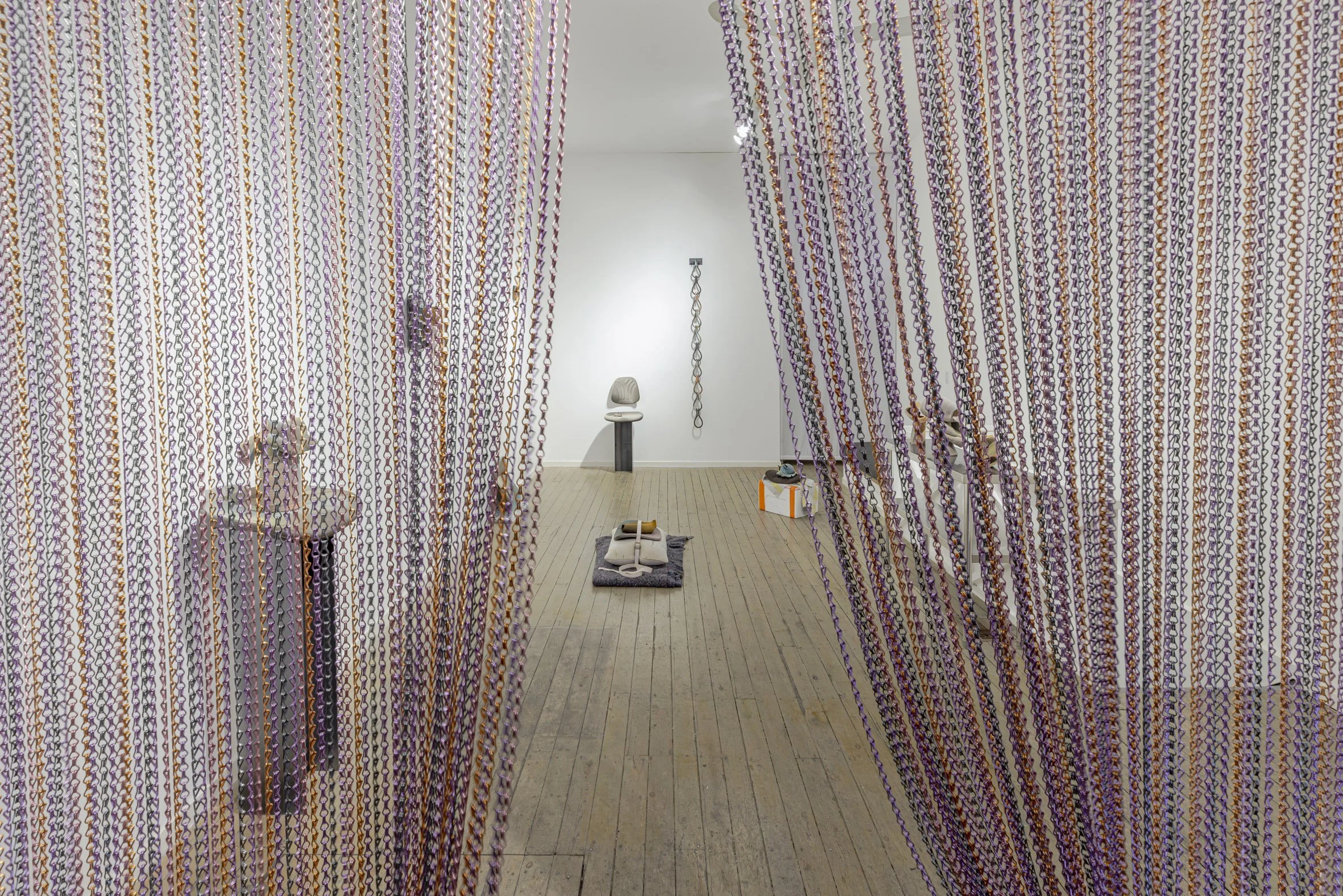
Jeremy Laing, Emergence (Striped), 2025. Anodized aluminum, airplane cable, ferrules, turnbuckles, hooks. 121 x 105 x ½ inches. Photography courtesy of Susan Hobbs Gallery.
Swishing through a serpentine curtain of chains suspended just beyond the entryway of Susan Hobbs Gallery, the sense is immediate that in Jeremy Laing’s latest exhibition, Mutuality, you are part of the show itself. Not just because you’ll navigate past the sublime ceramic vignettes within the space by passing through a series of conjoined curtains; but each piece in Laing’s show asks us to contemplate our relationships to the objects we encounter every day in an exhaustive endeavour to question how we, as sentient and non-sentient things, are all connected.
The works in this show were made during Laing’s residency at the European Ceramic Work Centre in The Netherlands, an opportunity typically comprising a 13-week stay. Laing, whose body of work encompasses sculpture, textile works and environmental intervention, said their residency pitch focused on mold-making – something the artist hasn’t had experience with. And while they entered into their time at the Centre thinking the work would go in one direction, they soon came to pivot with the help of a humble work chair that was in Laing’s studio space.
Laing then settled on the textural and relational exploration of concepts like reality and uncanniness; the shaper and the shaped; and symbiosis and heirarchy. All through a lens of identity-building, affirmation and resistance.
It’s no surprise then that in combination with their magnetizing ambiguity, the works in this show possess a pleasing bodily quality. One sculptural gesture resembles a protruding tongue ejecting from a cylindrical form, while another – hidden in a cavern-like interior in the work Sighting Device – looks like a uvula turned upside down. Each form is unbelievably rendered in a purposefully earthy-looking clay and airbrushed in a range of spectrums in such a way so as to interact with light in truly gratifying narrative ways.
“There’s a sense of shadow to them,” Laing noted as we discussed Mutuality’s finer points, adding that the colouration mixed with the specific tactility results in a look resembling the effect of “shantung or shot silk”. I had to smile at this reference knowing Laing’s former role as a fashion designer.
This exhibition, which runs until January 10th, is generous in concept and in execution. Each squished surface, and the way smaller elements are combined in a studied, disruptive harmony, take time to take in; it demands the viewer is generous with their attention as well. Here, Laing shares the process, both in thought and in craft, of making this array of new pieces.
Tell me more about this residency in The Netherlands. What brought you there, and what you were hoping to accomplish by going there?
I found out about it from Shary Boyle, who had gone. I think she posted something on Instagram describing it as a compelling, interesting experience and it was in the lead up to their open call for residencies a couple of years ago. I took that as a sign to apply.
I've done ceramics since I was a teenager. I did hand-building initially, and then in the last few years I’ve done more wheel throwing – but I've never done any casting or molding. My pitch to them was to explore clay as a sort of material analog for the production of various social formations and the ways that people either fit themselves into that, or don't, or some kind of complex combination of the two. I was thinking about mold making as a less dualistic and less hierarchical process; so, less centered around the positive and the negative, or the object and the mold, and more as something mutually shaping. It’s the idea that things that are shaping each other concurrently, instead of one thing being shaped by a kind of ‘master’.
And where did this thinking lead you?
When it comes down to it, when you’re in the mold making workshop you rely on a positive and negative. There are very pragmatic, technical reasons for that. I thought, oh, this is as strict as it seems. But then I landed, literally, on the chair they gave me to use while working. I was settling into the space, and wheel throwing initially, just to get my hands dirty and get the ideas flowing. I began lifting different textures from the space in a citational way: the rubber doormat, the steel grill in my floor, the drain grade. I laid a slab of clay on my chair because it had such interesting ridges and texture. I sat on a slab of clay, doing whatever other work I was doing for the day.
It struck me as being a conceptual way into the questions around mold making that I was coming there with, in the sense that the chair itself is both a molded object and one that conditions – one that molds you in your use of it through human factors like design and ergonomics. All these things that sort of refigure a ‘universal body’ in ways that purport to account for all possibility. But of course, you also end up impacting this chair in your very own way over time; maybe it takes on your shape a little bit, or you wear the edges down, leaving traces on something that is also shaping you in turn.
This became a way to think about circularity – of shaping and being shaped, shaping and being shaped, shaping and being shaped, instead of a linear, hierarchical, master/replica kind of formulation of identity, of experience, of going about the world. The idea of, yes, we are molded by the conditions that we are given but at the same time, it's within our capacity to change them, to push back on them, to find different shapes within them. And this idea of the emptiness of the mold as not a lack or a hard limit, but a kind of surface for multiple forms of elaboration.
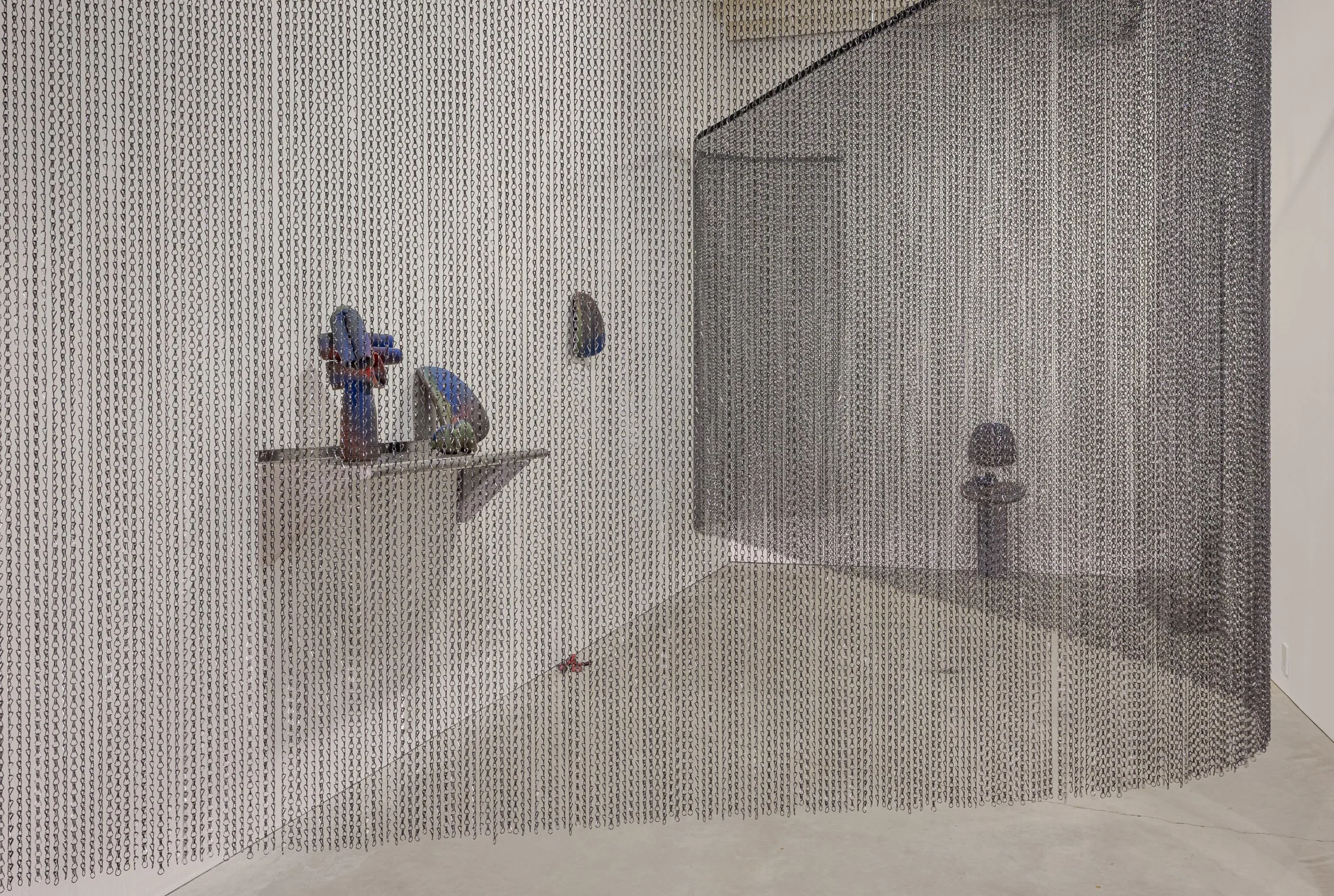
Jeremy Laing, Emergence (Squiggle), 2025. Anodized aluminum, airplane cable, ferrules, turnbuckles, hooks, theatre lights, boom plates and stands, extension cord, power bar. 10 x 16 x 480 inches. Photography courtesy of Susan Hobbs Gallery.
Let’s talk more about the creation of the works in the show. What you were just saying makes me think of the colourations of the pieces, and their textures, which to me seem like they contribute to adding a sort of patina to the works.
Most of the pieces are press molded, which is a kind of molding where instead of slip casting, you're pouring in a liquid clay. In this case, you're manually spreading a kind of stoneware clay into the surface, which means that then you can also hand build with that clay or wheel throw with that clay. It's a way of having different kinds of forms of making, but with the same base material.
I was using a dark red earthenware that, when you overfire it, goes kind of blackish-brown. I was going for a sort of ‘velvet Elvis’ kind of painting where the colour is applied to a dark brown so what happens is that the shadow kind of shows through from reverse. You're basically adding the highlight. The application of colour is not a glaze; I used engobe, a pigmented liquid clay, that I airbrushed on and then fired in one go. It’s clay on clay, and it's fired at the viscous stage with no glaze, and what that achieves is almost a flocked velvetiness and a sense of material confusion. Like, is this squishy? Is this soft? Is this brittle? Is this hard? You can't quite tell.
I was using the airbrushing in such a way so as to accentuate a sense of orientation or directionality. The form of the chair really lends itself to this because it has a pattern and then deeper still, it has a texture. Depending on how close you are to it – how proximal you are, as if you are your position as a viewer – either the pattern or the texture emerges. It’s like there’s a reward upon getting closer or pulling away; each has a different kind of ambiance. The airbrushing highlights all of these levels of detail.
And what about the colours you’re using? How do they tie into the theme of the show?
The works downstairs are in more of an RGB palette and upstairs, they’re more polychrome. I’m working with the airbrush in such a way that all of these tertiary relationships are emerging in a sense of gradient. So again, there’s a non-dualistic, spectrum-oriented thinking in this active field of things merging and blending with each other, where there is no real line of distinction between the red and the blue. It’s sort of seamless.
Tell me about the different forms we see and the use of space in the show.
The chains were both the first and the last gestures, so they became a kind of bracketing or book ending for the rest of the work. The first move was the metal chain downstairs, which sets up an intervention that shields the show from the front door so that there's a sense of being veiled. You can't see all the way to the back of the space from the front with the exhibition up, which normally you can.
I'm interested in instilling or cultivating, not a sense of mystery, but specifically creating different zones and then forcing moments of transition where at first, you feel like you can walk around the chain but then you're confronted with the fact that you must pass through it. You must pick a point of transition and go through, so partly, that's about spatial delineation. And it’s partly about the sonic texture to the space that responds to your motion through it. There’s a kind of kinetic activation of the space simply by your presence walking through it and leaving traces, as we do.
It was important to me that it'd be chain versus fringe or beads on a string, for instance, because of the conceptual implications of the repeating link that's holding and being held, holding and being held, holding being held; again, we see a mutuality. But the idea there is that it speaks to the philosophical concept of emergence, which is something that accrues from the sum of its parts – that is indivisible from them – but there’s a next level effect that emerges from them, like the murmuration of birds. It also speaks to texture and the repetition of self-similar modules that are each ultimately different, even though they appear the same. For me, these are ways of thinking about the idea of the collective.
Upstairs, the chain piece made out of ceramic was the last work that I made towards the end of the residency. That’s a time when you don’t really have the opportunity to make something big that will take three weeks to dry, but I could make small bits that would dry relatively quickly. And again, there’s the idea of accumulating something large out of smaller elements which, when linked together, emerge as a sort of totality.
And why was the concept of mutuality on your mind?
I think it's largely wish-based. It’s a way of thinking about being together that is less predicated on the separation between the self and other, and of hierarchies that enable and maintain – often quite deliberately – the wholesale devaluation of life. I think about this a lot as a queer person who's always felt a strong sense of difference, and the ways that being tethered to that difference by other people has at times felt oppressive, and at other times felt emancipatory. There’s the sense of tightly holding and being held, and how this can both be a gesture that limits but also a gesture that supports.
Ultimately, I’m dwelling in the complexity of being a person who's forced into administrative categories, as we all are – but some more comfortably than others. It's always difficult trying to maintain a sense of generosity towards seemingly normative modes and understanding that, yeah, though some people might inhabit them with more ease that it's not actually easy to be. And from this, thinking about it as a mutual condition, and as a condition that I hope leads to a more empathetic understanding of difference as something that is tied up in the concurrence of the self and other – that's if we even want to speak in those modes – or something like the soul and spirit, if we want to think in a different way about things that are mutually implicated.
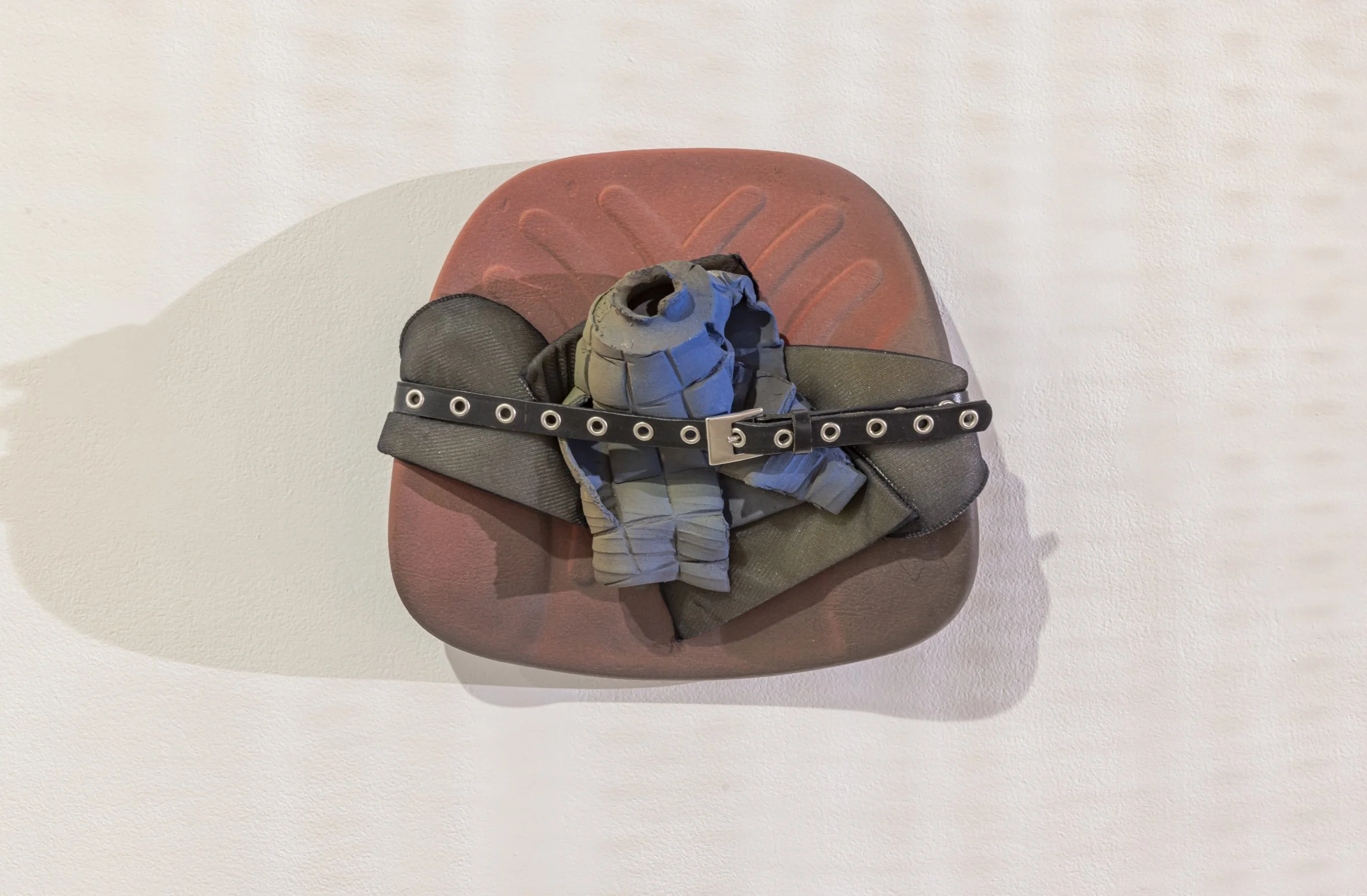
Jeremy Laing, Mutuality (Tension), 2025. Pigmented engobe on stoneware, deadstock shoulder pads, vintage belt (with thanks to Daniel). 12 ½ x 13 ½ x 5 inches. Photography courtesy of Susan Hobbs Gallery.
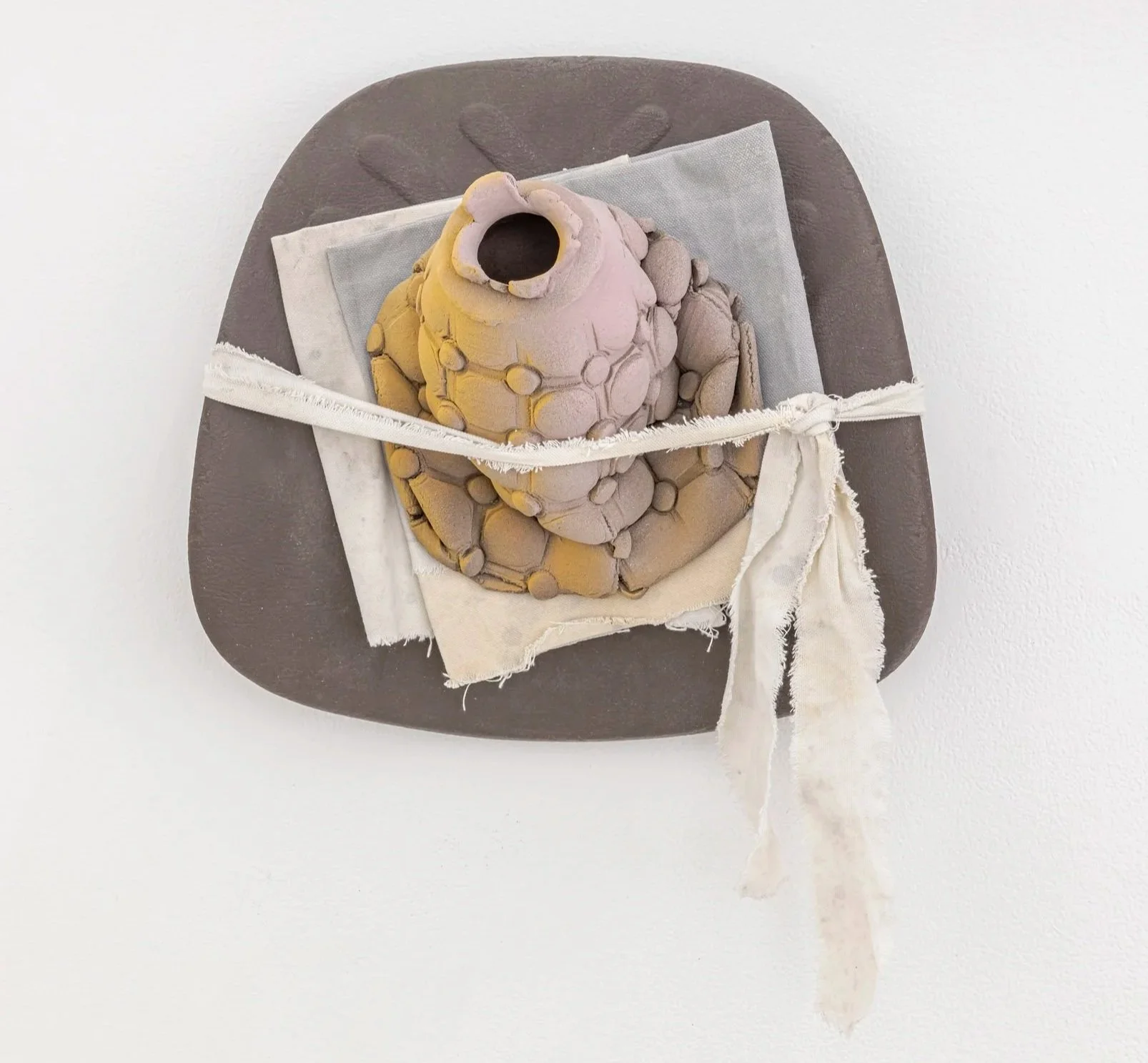
Jeremy Laing, Mutuality (Tension), 2025. Pigmented engobe on stoneware, cotton canvas salvaged from the European Ceramic Work Centre. 12 ½ x 13 ½ x 7 inches. Photography courtesy of Susan Hobbs Gallery.
Where does this show connect to or evolve from your other shows?
My work is always implicated in the space in which it occurs. My approach really begins with taking the ‘not enoughness’ of a set of conditions and trying to, through the exertion of some kind of gesture, bring about a change in them for, in my mind, the better or the more interesting. Materially, there's a connection to ceramics and textiles that have been ongoing in my practice for a long time in different ways, but without much rupture. But I'm definitely maturing and a deepening investment in these themes and materials and practices in a way that I'm proud of, and in a way that is revealing more and more to myself so it feels contiguous.
Do you have a favorite piece, or one that still sticks in your mind now that the series is complete?
There are two pieces, and they operate with the same series of elements but different palettes. They're both called Mutuality (Tension), and they are two wall works where there's a seat back, and pressed into that seat back is a vessel that was also rolled across a doormat, for instance, to pick up its texture and then platformed on the original back of my chair so as it dried, it took the shape of a number of different things from the environment in which it was made. Then there’s the simple addition of a belt for one piece, and a scrap of fabric tied around the other, so the elements are sort of locked into place in this kind of relationship that's tethering but also supporting, or restrictive but also saving it at the same time. Thematically, materially, and also technically – it's a wheel thrown work in conjunction with a cast form in conjunction with textile –all of these ‘threads’ are coming together and manifesting in those pieces in a way that is conceptually grounding.
Mutuality runs until January 10th, 2026 at Susan Hobbs Gallery.