Don’t Miss: PARTING/فراق
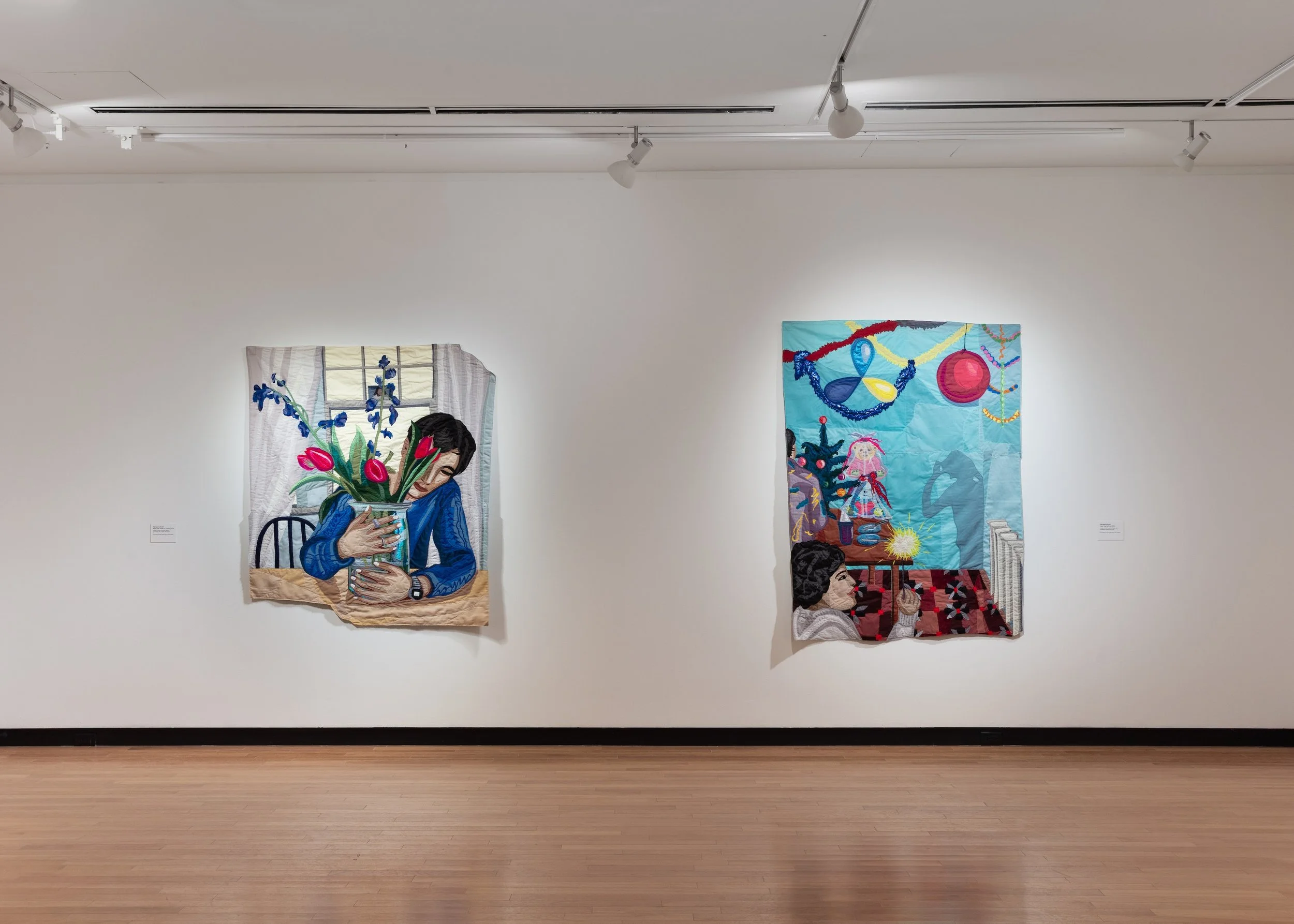
Installation view of PARTING/فراق. Photography courtesy of the Art Museum.
Written by Hana Lang.
On view at the Justina M. Barnicke Gallery at the Art Museum (part of the University of Toronto) until April 11, PARTING/فراقis Hangama Amiri’s first major solo institutional exhibition in Toronto; and it is an extension of an ongoing body of work exploring her personal history and diasporic experience. The tactile, flexible quality of Amiri’s pieces physically manifests feelings of nostalgia, longing, and hope, while her careful selection of textiles are expertly layered to create impressively detailed scenes. In 2025, Amiri was shortlisted for the prestigious Sobey Art Award for her series Reminiscences and Reminiscences II; many of the works exhibited now at the Art Museum were featured in her installation at the National Gallery of Canada last year.
Amiri’s work is rooted in her constantly shifting relationship to home. She and her family fled Kabul in 1996, resulting in an over nine year period of familial separation. While Amiri lived in Tajikistan with her mother and siblings, her father sought asylum in Denmark and later Norway, before reuniting together in Halifax in 2005. Drawing upon her family’s extensive collection of photographs, letters, and gifts which were exchanged during this period, Amiri translates these physical fragments of childhood memories into beautifully textured collages.
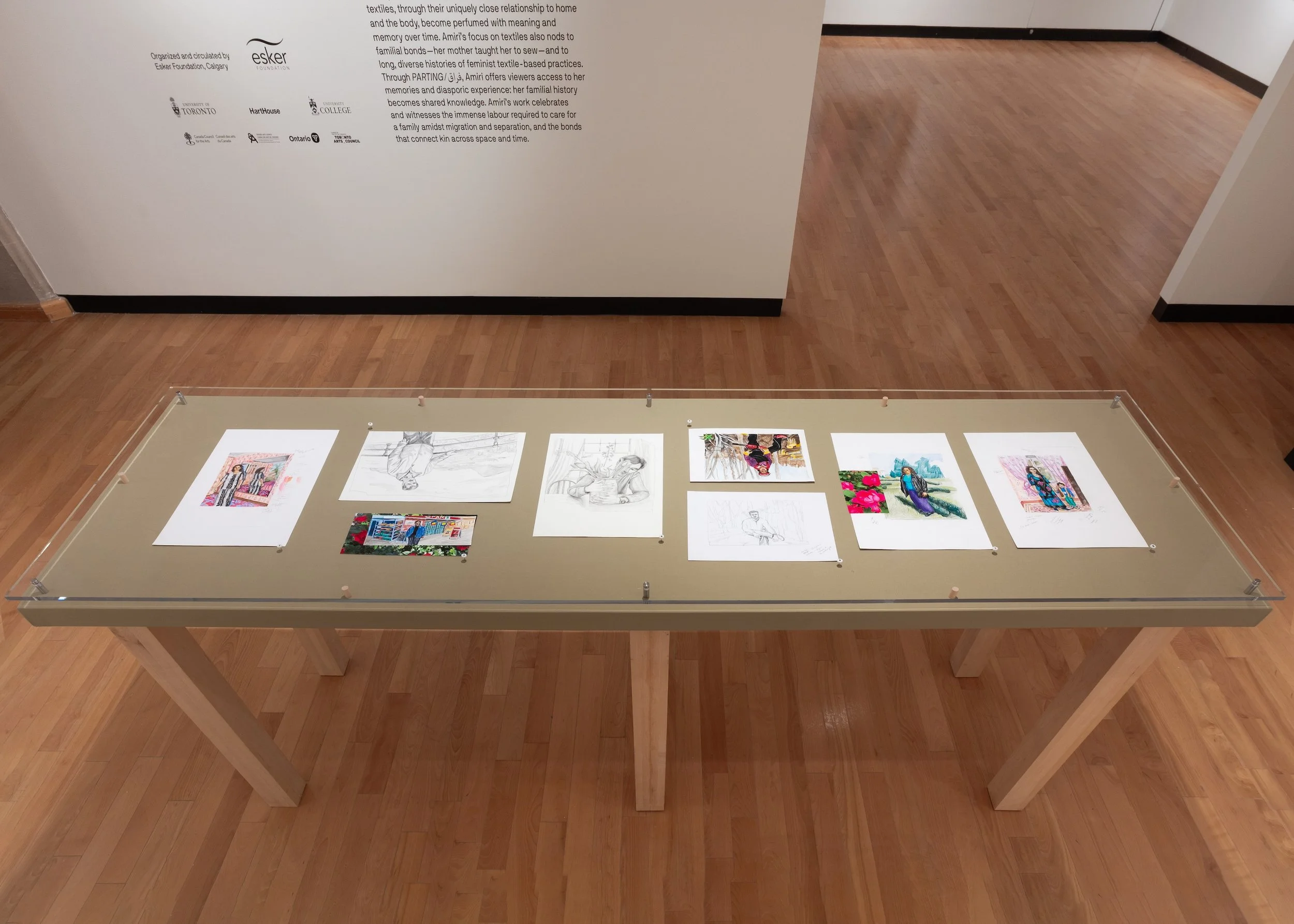
Installation view of PARTING/فراق. Photography courtesy of the Art Museum.
The exhibition opens with a series of preliminary sketches of her compositions. These drawings are dwarfed by their completed iterations, and present a rare opportunity to view Amiri’s creative process. It also brings her works together as separation later becomes physically represented curatorially: compositions depicting her father are isolated from those of her mother and siblings, which are showcased in a separate room.
Amiri’s work comes alive in her masterful manipulation of textiles, resulting in scenes that more closely resemble paintings. The visual qualities of the textiles Amiri employs are interlayered to create depth; light is captured by chiffons and tulles with an effervescence that fragments figures and objects, rendering shadows. In one work, Woman Before a Mirror (2022), Amiri layers fine strips of tulle to mimic the reflective quality of a mirror.
Amiri’s focus on textiles is also a nod to familial bonds, as her mother taught her how to sew. And she draws upon the rich history of feminist textile practices to speak to the geopolitical realities resulting in her fleeing Afghanistan in defiance of the Taliban’s evolving restrictions on women’s participation in society – enduring regulations on women’s dress include a ban on shiny fabrics because they reflect light and emit sound.
As a visual rebuff, Amiri resolutely uses an array of “demanding” textiles in her depictions of women existing in private and public spaces. In Portrait of a Woman with a Denim Jacket, the titular figure stands proudly in the foreground, her red lipstick and matching nail polish commanding attention. This provides a humanised perspective of an Afghan woman; one which gives her agency, contrasting the oftentimes forced anonymity in public spheres.
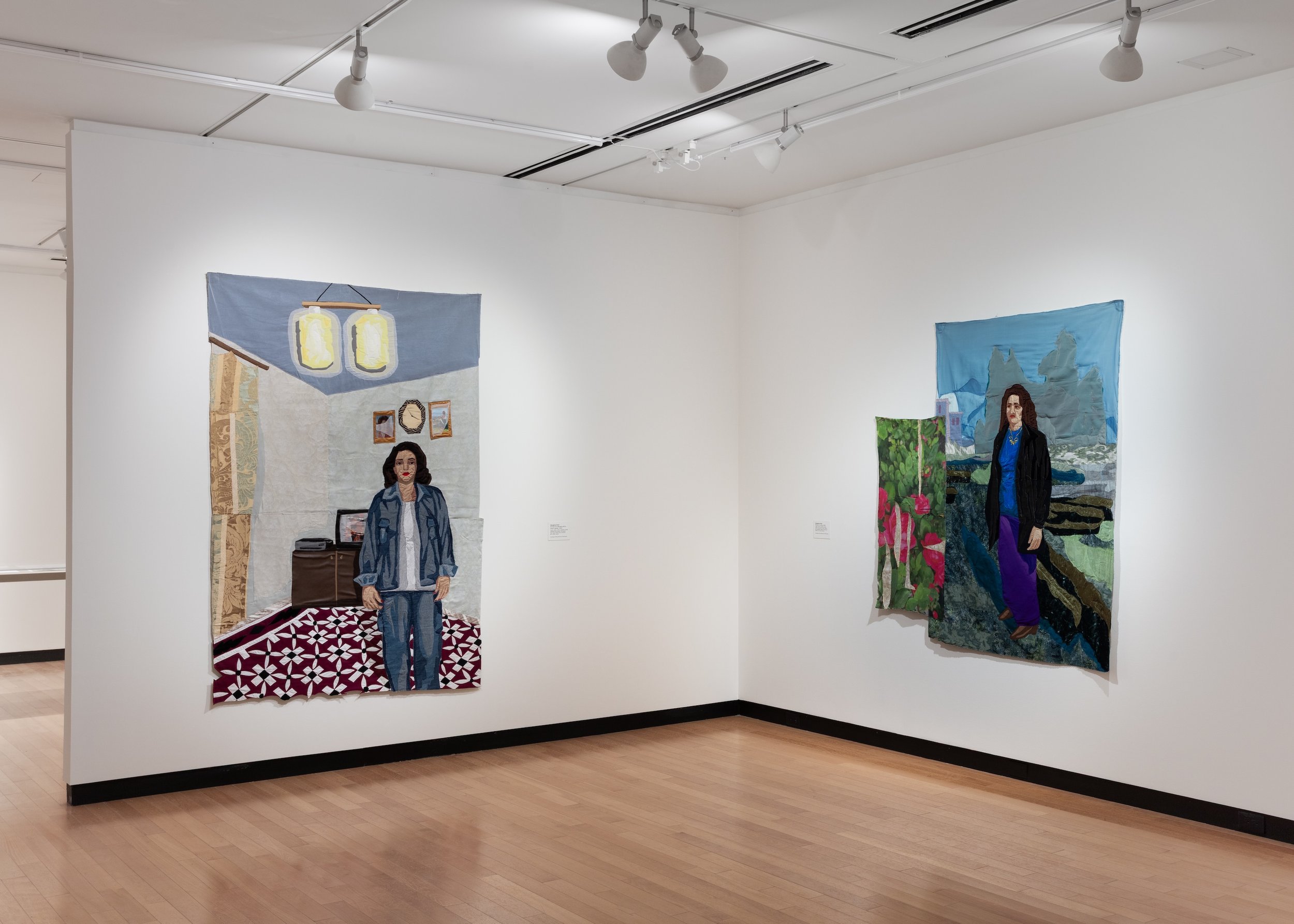
Installation view of PARTING/فراق. Photography courtesy of the Art Museum.
For this reason, Amiri’s works tend to be figurative and still life. She is interested in the power of representation, often referencing pop influences, class, and culture. Portrait of a Woman with a Denim Jacket (2022), contains subtle references to pop culture through the rendered television set obscured by a layer of textile used to create the illusion of glass. Across the hall in Portrait of a Man at the Grocery Store (2022), Amiri combines velvet, chiffon, and leather to imbue a scene of labour with a feeling of desire and hope for the future.
PARTING/فراق. runs until April 11th at the Art Museum at the University of Toronto.